A journey through Collio’s vineyards, producers, and wines that challenged what I thought I knew about Italy’s most familiar white grape.
A few weeks ago, I sat down with Stevie Kim, Managing Partner of Vinitaly International and the founder of the Italian Wine Podcast, in Miami for a short Instagram Live. Of everything we talked about, one line stayed with me:
“You guys are so anti–Pinot Grigio.”
She wasn’t entirely wrong.
For years, Pinot Grigio has been sold—especially here in the U.S.—as a simple, easy-drinking white. Crisp, clean, refreshing, reliable. The kind of bottle you order without much thought and drink without much expectation. And I’ll admit it: I carried that idea too.
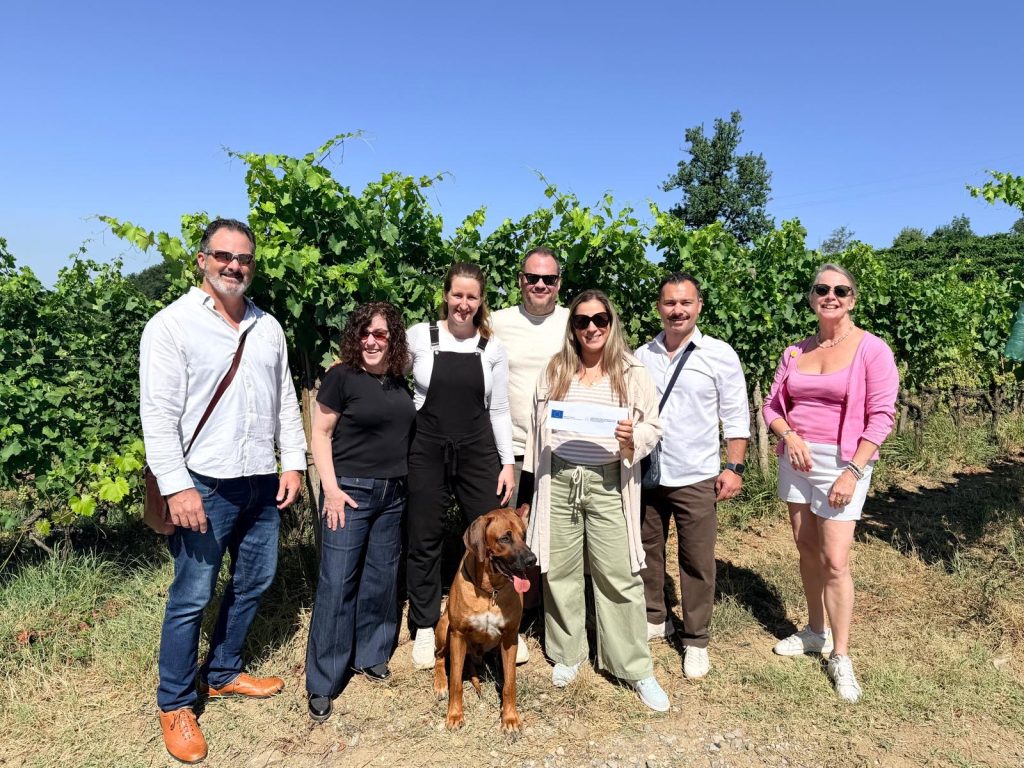
What I didn’t know was that a few weeks later I’d be standing in the hills of Collio, on a trip that would take that idea apart. What I found there wasn’t one style of Pinot Grigio but many—wines shaped by place, philosophy, patience, and terroir. From vineyards rooted in ponca soil to cellars where the wines are given years before they’re released, every producer showed me a different side of a grape most of us have quietly underestimated.
Collio didn’t just ask me to rethink Pinot Grigio. It made me wonder whether I’d ever really known it at all.
Arriving in Collio
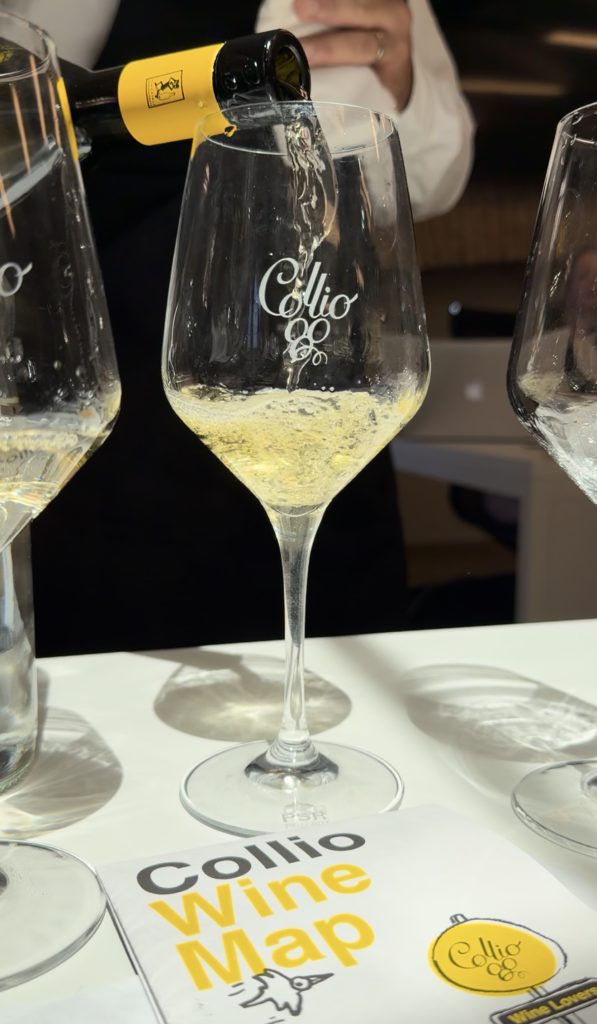
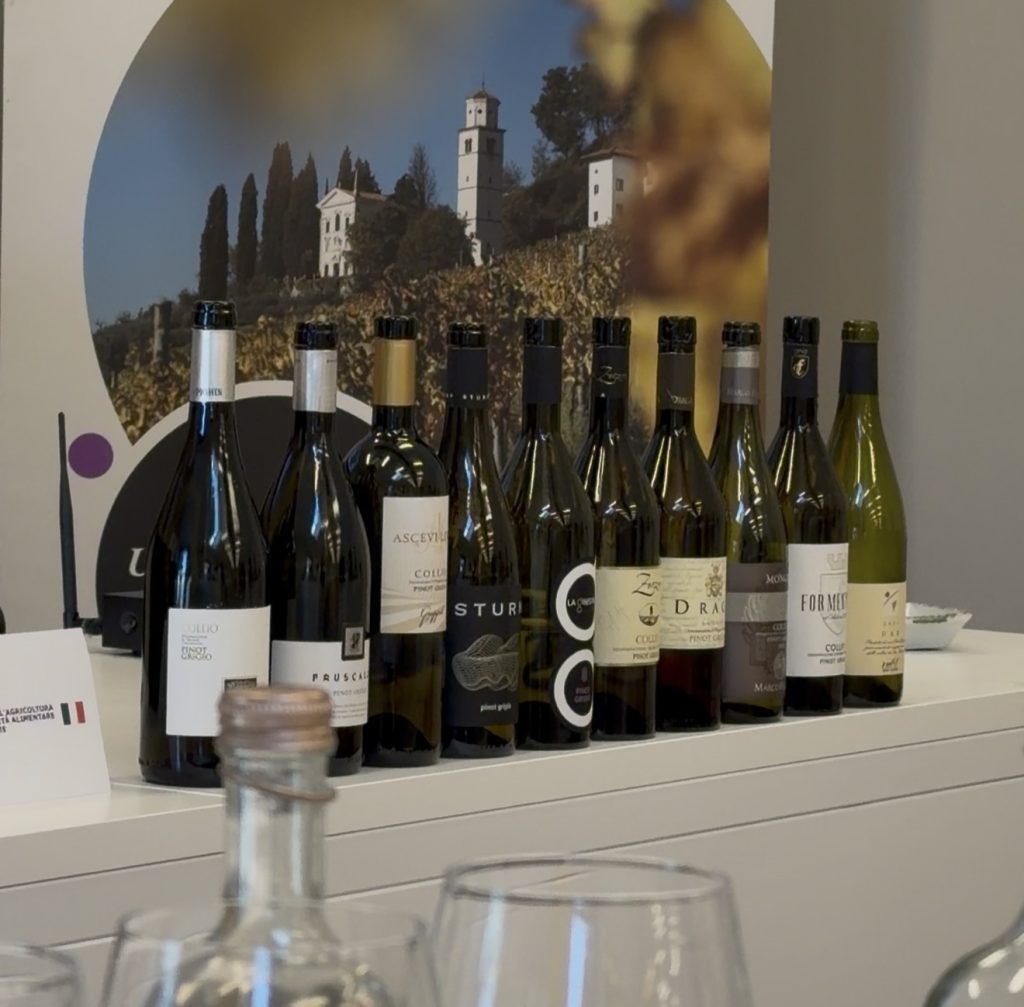
As part of a trade education trip organized by the Consorzio Tutela Vini Collio, our group gathered at the Enoteca di Cormòns, where wine educator Cynthia Chaplin led a masterclass on the region’s five principal varieties: Ribolla Gialla, Pinot Grigio, Friulano, Sauvignon, and Collio Bianco. The idea was simple—understand what makes Collio Collio before heading into the vineyards.
Every wine had its own story, but I kept coming back to the Pinot Grigios. They had more texture, structure, and personality than I expected, and it was my first sign that the Pinot Grigios of Collio were not going to match the stereotype I’d brought with me.
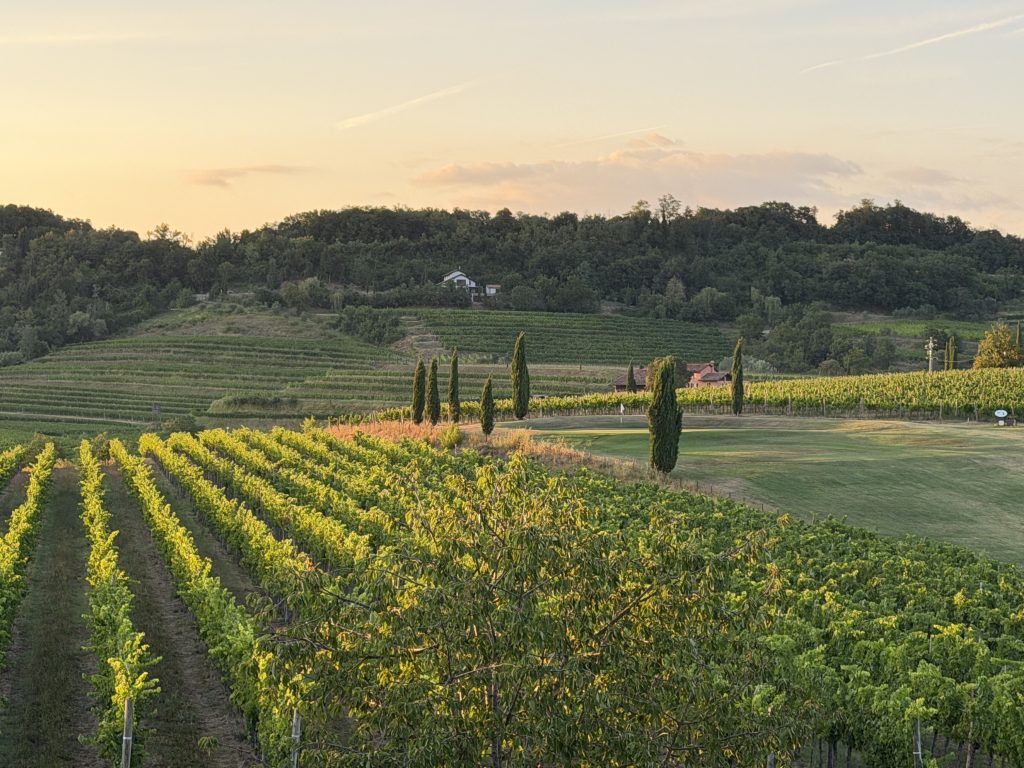
That feeling only grew as we left Cormons and drove through the region. The first thing I noticed was how peaceful it all felt. The villages are small, clean, and beautifully kept, with vineyards wrapped around nearly every hillside. It’s the kind of place where wine isn’t just an industry—it’s part of daily life.
Tucked into Italy’s Friuli Venezia Giulia region on the northeastern border with Slovenia, Collio is a small, crescent-shaped appellation of just over 1,300 hectares and roughly 300 growers. Its rolling hills create countless microclimates, where differences in elevation, sun exposure, and the cooling Bora winds all leave their mark on the wines. Today nearly 87% of Collio’s production is white—a reflection of both the climate and the region’s long reputation for some of Italy’s finest whites. Shaped by Italian, Slovenian, and Austro-Hungarian heritage, Collio is a place where cultures have blended over time in a way you notice everywhere: in the architecture, the food, and the names and stories behind many of the wineries.

Why Pinot Grigio?
In the U.S., Pinot Grigio has become the dependable “house white.” It’s often picked early to keep its acidity, fermented in stainless steel, bottled young, and enjoyed for its fresh citrus and orchard fruit. There’s nothing wrong with that—it has introduced millions of people to Italian wine—but it’s only one interpretation of the grape.
In Collio, the thinking starts somewhere else: in the vineyard. The rolling hills, cool nights, and distinctive ponca soils—a marl-and-sandstone mix formed millions of years ago—naturally limit vigor and push the wines toward real minerality and structure. Instead of chasing big yields, many producers deliberately make less, so each site can show its own character.
The differences carry into the cellar. Some producers stay with stainless steel to protect purity and freshness; others ferment or age in large oak casks, in concrete, or on extended lees to build texture and complexity. A few lean into skin contact, drawing color from Pinot Grigio’s coppery skins and making wines with more depth, grip, and staying power.
What surprised me most wasn’t that they used different techniques—it was that none of them were trying to make the same wine. Each had a distinct philosophy, and yet they agreed on the thing that matters: Pinot Grigio can be a serious, terroir-driven variety, one worth treating as an expression of both place and personality.
By the time I’d visited a few estates, I realized I wasn’t tasting different versions of Pinot Grigio at all. I was tasting different interpretations of Collio itself.
Memorable Pinot Grigios
Paraschos – Pinot Grigio DOC Collio Riserva 2021
Technical Notes: 100% Pinot Grigio (an Alsatian clone) from the Slatnik single vineyard in San Floriano del Collio—one of the estate’s highest, windiest sites, where low yields, early harvesting, and clean marl soils concentrate the fruit. About eight days of skin maceration with native yeasts, then a year in large oak casks, bottled unfiltered and without added sulfites.
Why It Stood Out: This was the first Pinot Grigio we tasted at Paraschos, and it set the tone for everything that followed. In his quiet tasting room, Jannis Paraschos led us through the wines with an almost Zen-like calm that seemed to mirror the way he makes them. The wine poured a deep copper-rosé with dark amber tones and a delicate onion-skin rim. A subtle oxidative note played against a long finish and a distinctive leafy character that lingered—and reshaped what I thought Pinot Grigio could be.
Website: https://www.paraschos.it/vino/41/ita
Terčič – Pinot Grigio “Dar” Collio DOC 2024
Technical Notes: 100% Pinot Grigio from estate vineyards in San Floriano del Collio, where cooler hillside sites and the small but excellent 2024 vintage gave fruit of unusual freshness, balance, and concentration. A brief two-hour skin maceration draws out gentle color and texture, followed by a touch of oak that adds depth without covering the fruit.
Why It Stood Out: Dar means “gift” in Slovenian, and the name fits—this is a wine made to show the territory with elegance and typicity rather than force. In a lineup of ten Pinot Grigios, it caught me right away with its textural palate, bright savory edge, and finesse; I kept picturing it on a fine-dining table. Meeting Ana Terčič that evening gave it even more meaning. She joined the family winemaking in 2023 after finishing her degree in enology, and she was warm and clearly happy to see us enjoying her family’s wines. Her enthusiasm said everything about the care behind a bottle that speaks of place rather than power.
Website: https://www.tercic.com/
Raccaro – Pinot Grigio Collio DOC 2025
Technical Notes: Made in Cormòns and only in select vintages (around 2,500 bottles). Whole-cluster pressed and fermented in stainless steel with no oak, then aged on fine lees with bâtonnage. The family name comes from the Slovenian Raccar, “shrimp fishermen”—a nod to their heritage.
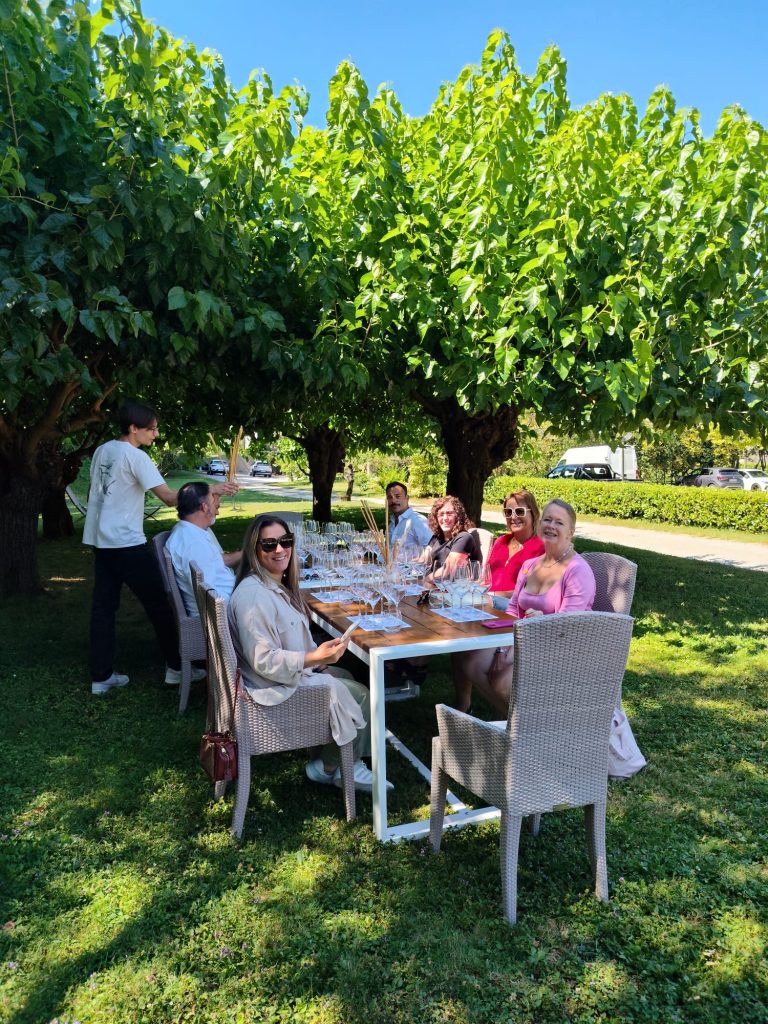
Why It Stood Out: I first tasted Raccaro’s Pinot Grigio at the winemaker meet-and-greet, then again after visiting the estate, where Luca Raccaro—alongside his father, Dario, and the rest of the family—makes honest wines shaped by the site rather than the cellar. There’s nothing flashy here: floral aromatics, vibrant minerality, crisp freshness, and a clean, faithful read of the estate’s ponca soils. After the tasting we gathered around the family table for lunch featuring a simple plate of spaghetti al pomodoro—a reminder that behind every bottle is a family whose warmth is as memorable as the wine. More than any tasting note, that’s what stayed with me.
Website: https://www.raccaro.it/en/the-wines/
Damijan Podversic – Pinot Grigio 2024 (tasted from barrel)
Technical Notes: 100% Pinot Grigio from the Monte Calvario vineyard, one of Collio’s southernmost sites, looking out toward the Adriatic and the lagoon of Grado. Fifteen hectares of vines grow on classic ponca— sandstone and marl—at 110–140 meters, with eastern exposure and naturally low yields of just 40 quintals per hectare.
Why It Stood Out: Tasted straight from barrel in the family’s newly finished cellar, this unreleased 2024 already showed where it’s headed. Damijan Podversic still guides the estate, but his daughter Tamara is learning at his side, and she brings real technical precision to the next generation. The family’s approach embraces wood and skin maceration—not to wear the “natural” label, but simply to make the best wine they can. Tamara described each vintage as a piece of music: quiet at first, then building in intensity, width, and texture across the palate. The 2024 was exactly that—massive tannins, serious concentration, and the structure to evolve for years. Watching her walk us through each barrel with calm focus, I kept thinking of a surgeon in an operating room: precise, unhurried, completely in tune with every decision.
Website: https://www.damijanpodversic.com/en/
Honorable Mentions
• Ferruccio Sgubin Pinot Grigio Collio DOC 2023 (https://www.ferrucciosgubin.it/)
• Toros Pinot Grigio Collio DOC 2015 (https://www.vinitoros.com/en/)
• Polje Pinot Grigio “Laviano” Collio DOC 2022 (https://sutto.it/it/sutto-cantine/polje)
• Borgo Conventi Pinot Grigio Ramato Collio DOC 2024 (https://www.borgoconventi.it/en/)
I didn’t come to Collio to study Pinot Grigio. I came to experience the region—to meet its producers, walk its vineyards, and understand what makes this corner of Friuli Venezia Giulia so special. Somewhere along the way, though, Pinot Grigio became the story that kept pulling me back.
Thinking again about that conversation with Stevie Kim, I’ll give her more credit than I did at first. Maybe a lot of us have only ever met one side of Pinot Grigio.
I didn’t leave with a single favorite, and I never expected to. I left with a deeper appreciation for a place where every bottle carries the personality of its maker and the character of its vineyard. If there’s one thing I’m bringing home, it’s this: sometimes the wines we think we know best are the ones with the most left to teach us.